
policy
batteryTwo Lithium-Ion Battery Fires in One Afternoon: Why Toronto's Fire Chief Calls It the City's Top Safety Risk
Toronto Fire Services responded to two lithium-ion battery fires hours apart on Sept. 6 — an e-bike blaze near St. Clair and Bathurst and an apartment fire near Crescent Town. Chief Jim Jessop says battery fires are up 200 per cent since 2022 and is pushing for fire-code changes.
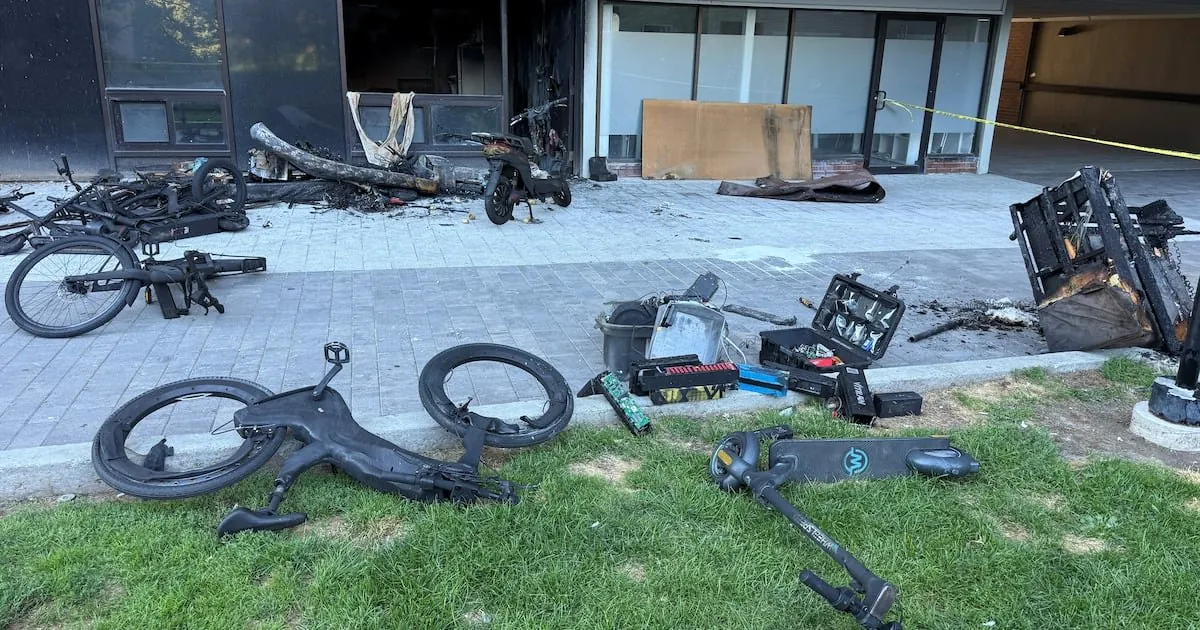
Toronto Fire Services responded to two separate lithium-ion battery fires within hours of each other on Sunday, Sept. 6 — the latest in what the city's fire chief calls the greatest public safety risk facing Toronto.
The first fire broke out in a laneway near St. Clair Avenue West and Bathurst Street around 11:23 a.m., when an e-bike caught fire between two buildings, according to Toronto Fire Services. Crews knocked it down and the fire did not spread, but two people were assessed by Toronto paramedics for smoke inhalation and transported to hospital with minor injuries, Toronto Police Operations said.
Second fire, two hours later
More than two hours later, around 1:48 p.m., crews responded to a fire inside an apartment building near Crescent Town Road and Victoria Park Avenue. Toronto police said a lithium-ion battery caught fire in a ground floor unit. No injuries were reported, but CTV News reported the unit was destroyed.
'The greatest public safety risk'
Toronto Fire Chief Jim Jessop told CTV News recently that fires caused by lithium-ion batteries pose the greatest public safety risk in Toronto. The city has seen a 200 per cent increase in lithium-ion battery fires since 2022, he said.
"The data we've gotten out of our investigations is it's predominantly the batteries that are not regulated, do not meet a standard, that anybody can go on any internet site to bring into this country and use, quite often for purposes or with devices for which they were not originally designed," Jessop said.
That finding is why the chief has been calling on federal and provincial governments to make regulatory changes and amendments to the fire code. "Our firefighters are going into buildings that are more unpredictable, that are more dangerous, and that the fires are a lot more intense and toxic than they ever were," he said.
Why this matters for Canadian EV and e-mobility owners
The fires put a sharp point on a battery-safety debate that reaches beyond e-bikes. The cells involved in most Toronto incidents are uncertified packs bought online — not the UL-certified batteries automakers install in electric vehicles, which are built to federal motor-vehicle safety standards. But as e-bikes, scooters and home energy storage multiply in Canadian homes and garages, the regulatory gap Jessop describes sits between consumer-product rules and a fire code written before micromobility existed. For EV owners, the practical takeaways echo what fire services across the GTA have been preaching: charge with the manufacturer's equipment, never with cheap replacement packs, and don't charge large batteries unattended or beside exit routes.
Toronto's lithium-ion battery fire calls are on track to reach 100 by year's end — a 250 per cent spike since 2022, according to the fire chief. Two fires in one September afternoon is, by the numbers, no longer unusual.
Looking for EV deals, insurance, or financing? Check out our partner deals and offers.
If you found this guide helpful, use our Tesla referral link for free Supercharging credits on a new Tesla purchase or lease in Canada.
Next story · swipe left
Next story
11 EVs Under $41,000 in Canada This September — Fiat 500e Drops to $29,865 After Rebate
5 min read
September 2026 manufacturer discounts plus the federal EVAP rebate put eleven electric models below $41,000 in Canada, from the Fiat 500e at $29,865 to the Toyota C-HR at $39,185. Here are the numbers.
The Charge Brief
Get Canada’s EV transition in your inbox
One email a day. No spam, unsubscribe anytime.