
industry
Ford's Model e Division Posts US$1.1 Billion Q3 Loss, but Narrower Than a Year Ago
Ford's electric vehicle division posted a US$1.1 billion (C$1.5 billion) EBIT loss in Q3 2026 — 25% smaller than a year earlier — as falling sales, the F-150 Lightning discontinuation, and Mach-E production right-sizing weigh on the business.

Ford's electric vehicle division, Model e, posted an EBIT loss of US$1.1 billion (C$1.5 billion) in the third quarter of 2026, according to the company's earnings report released Wednesday. The loss is down 25% from the same period a year earlier, but the division's EBIT margin worsened to negative 86.5%, compared with negative 79.1% in the third quarter of 2025.
What drove the numbers
Model e recorded revenue of US$1.2 billion (C$1.7 billion), down 31% from US$1.8 billion a year earlier. Wholesale deliveries fell the same 31%, dropping from 50,000 vehicles to 34,000. Ford attributed the decline to the discontinuation of the F-150 Lightning and to "right-sizing" Mustang Mach-E production to match customer demand.
For the first nine months of 2026, Model e generated US$3.5 billion (C$4.9 billion) in revenue, down 35%, and recorded a cumulative EBIT loss of US$2.75 billion (C$3.9 billion).
The bigger picture
Despite the EV losses, Ford's overall business stayed profitable in the quarter. The automaker reported third-quarter revenue of US$49.5 billion (C$69.5 billion), net income of US$2.0 billion (C$2.8 billion), and adjusted EBIT of US$2.7 billion (C$3.8 billion). Ford also raised its full-year adjusted earnings guidance to between US$10.5 billion (C$14.7 billion) and US$11 billion (C$15.4 billion), up from its previous forecast.
The company left its full-year Model e loss forecast unchanged at approximately US$4.0 billion (C$5.6 billion), signalling that the electric division is still expected to be a drag on Ford's bottom line for the rest of the year.
What this means for Canadian buyers
The numbers matter for Canadian EV shoppers in two ways. First, the F-150 Lightning's discontinuation narrows the range of electric trucks available in Canada, pushing buyers toward other brands for a full-size EV pickup. Second, as Ford right-sizes Mach-E production, Canadian buyers should expect tighter availability of the compact SUV, which has been one of the more affordable mainstream EVs on the market. Ford says it is continuing to invest in next-generation, more affordable EVs and its Ford Energy business, so the long-term direction is still electric — even as the near-term financial picture stays difficult.
Looking for EV deals, insurance, or financing? Check out our partner deals and offers.
If you found this guide helpful, use our Tesla referral link for free Supercharging credits on a new Tesla purchase or lease in Canada.
Next story · swipe left
Next story
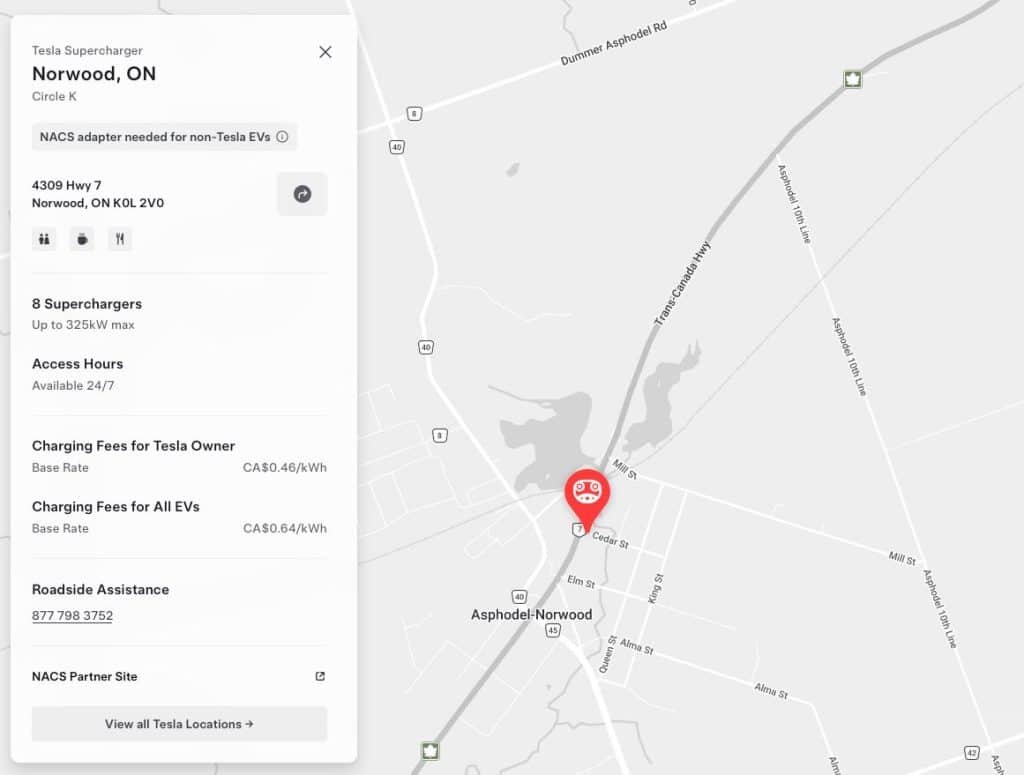
Tesla Opens an 8-Post V4 Supercharger in Norwood, Ontario — $0.46/kWh for Owners
3 min read
A new Supercharger at 4309 Highway 7 in Norwood (Ontario) went live with eight V4 posts up to 325 kW. Tesla owners pay $0.46/kWh; other EV drivers pay $0.64/kWh and need a NACS adapter. Part of a wider Ontario build-out.
The Charge Brief
Get Canada’s EV transition in your inbox
One email a day. No spam, unsubscribe anytime.