technology
costsGas, Hybrid, or EV: Which Vehicle Costs Less in Canada Over 5 Years?
A new Rates.ca analysis of gas, hybrid, and EV ownership costs across four segments shows gasoline models still winning upfront, while EVs close the gap by year five — except in SUVs, where gas remains dominant.
Gasoline vehicles remain the cheapest option upfront in three of four Canadian vehicle segments, according to a new Rates.ca ownership-cost analysis. But the same report finds that electric vehicles narrow the gap significantly over a five-year ownership window, flipping from cost disadvantage to advantage in at least one luxury segment and nearly matching gas in compact sedans.
The study compared total cost of ownership — including purchase price, taxes, rebates, insurance, licensing, maintenance, and fuel or charging costs — across compact sedans, luxury sedans, midsize SUVs, and passenger trucks. The analysis assumed 20,000 kilometres of annual driving and used Ontario electricity rates to calculate EV charging costs, which came in at 14 to 18 percent of comparable gasoline fuel costs in every segment.
The five-year verdict by segment
- Compact sedan: Gas wins years one through four; hybrid Honda Civic Sport HEV wins year five at $63,158 versus $64,193 for the Kia EV4 Light.
- Luxury sedan: Gas BMW 530i xDrive wins year one; BMW i5 xDrive40 EV wins by year four at $122,632 versus $124,312 for the gas model, and is $133,875 versus $129,630 for the PHEV 550e.
- Midsize SUV: Gas Kia Sorento AWD LX wins across all five years, staying ahead of the EV9 AWD and Sorento hybrid.
- Passenger truck: Ford F-150 Lightning 4WD is the only EV that is cheapest from year one, widening its lead to 23 percent over gas and 30 percent over hybrid by year five.
Why fuel savings alone do not guarantee a cheaper EV
Low electricity rates make EV fuel costs a fraction of gasoline, but higher purchase prices, insurance premiums, and maintenance assumptions mean the savings take years to compound. In the SUV segment, the Kia EV9's much higher upfront cost keeps it behind the gas-powered Sorento for the full five-year window despite far lower charging bills. Even with government rebates, only two of the twelve vehicles analysed qualified for incentive programs: the Kia EV4 ($5,000) and the Kia Sorento Hybrid ($2,500). The Ford F-150 Lightning did not qualify because its price exceeds the federal EVAP cap.
What this means for Canadian buyers
Rates.ca notes that fuel prices alone rarely change purchasing behaviour until household fuel spend reaches roughly 2.5 to 3 percent of income and elevated prices persist for six to twelve months. For most shoppers walking onto a dealer lot today, the sticker-price difference still dominates the conversation. The report suggests that EVs become more competitive the longer a buyer plans to keep the vehicle — so anyone trading out of a five-year lease may never see the full payback, while a long-term owner can let lower charging costs do the work.
If you are shopping in the truck segment, the data is clear: the Ford F-150 Lightning is the only EV in the study that posts the lowest all-in cost from day one. For sedan and SUV buyers, the math still tilts toward gasoline or hybrid unless you are committed to keeping the vehicle long enough for the charging savings to outrun the premium.
Looking for EV deals, insurance, or financing? Check out our partner deals and offers.
If you found this guide helpful, use our Tesla referral link for free Supercharging credits on a new Tesla purchase or lease in Canada.
Next story · swipe left
Next story
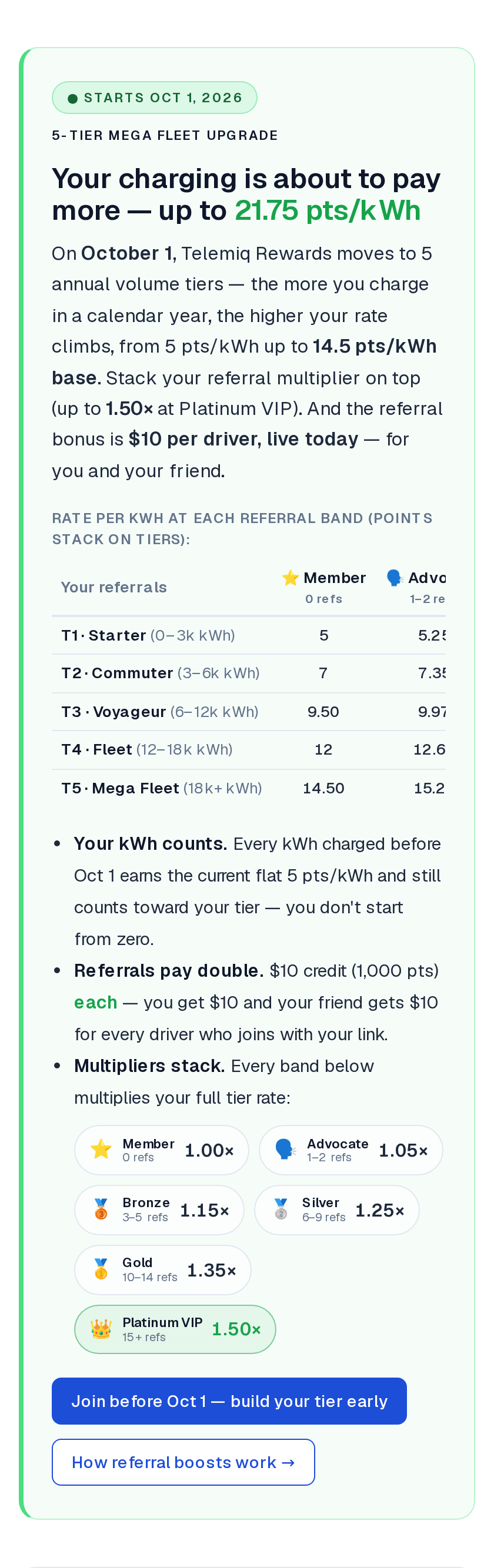
Telemiq Rewrites Its Rewards Math: Five Annual Tiers Take Over October 1 — and Home Charging Could Pay Up to 21.75 pts/kWh
7 min read
The Canadian EV rewards platform moves from a flat 5 pts/kWh to five calendar-year volume tiers reaching 14.5 pts/kWh, stacked with a referral multiplier up to ×1.50 — a natural ceiling of 21.75 pts/kWh — plus $10 per qualified referral, each side.
The Charge Brief
Get Canada’s EV transition in your inbox
One email a day. No spam, unsubscribe anytime.