deals
Telemiq Rewrites Its Rewards Math: Five Annual Tiers Take Over October 1 — and Home Charging Could Pay Up to 21.75 pts/kWh
The Canadian EV rewards platform moves from a flat 5 pts/kWh to five calendar-year volume tiers reaching 14.5 pts/kWh, stacked with a referral multiplier up to ×1.50 — a natural ceiling of 21.75 pts/kWh — plus $10 per qualified referral, each side.
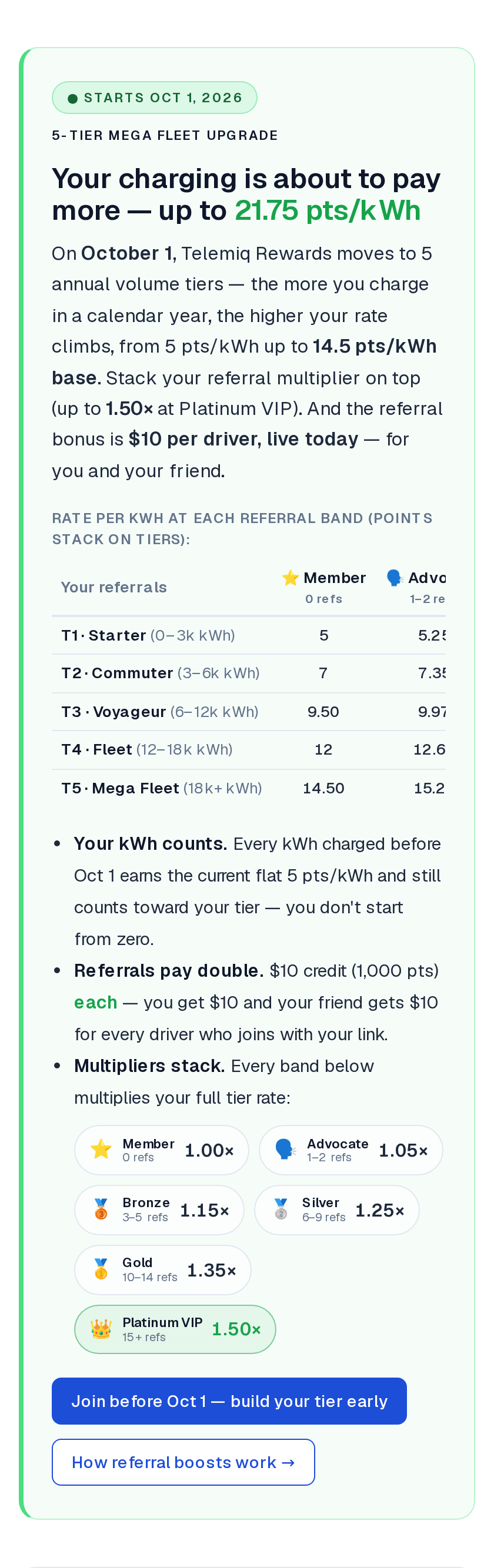
Update, September 20, 2026: Starting October 1, 2026, Telemiq Rewards is switching from its flat pay-per-kilowatt-hour model to a five-tier annual volume system that lifts the rate for every verified home kilowatt-hour as a driver's calendar-year total climbs. At the top of the new schedule — a high-mileage driver charging more than 18,000 kWh a year with a full referral network behind them — the effective rate reaches 21.75 points per kWh, or roughly $0.22 per kWh at the program's 100 points = $1.00 (C$) conversion.
Telemiq pays Canadian EV drivers for verified home charging, funded by Canada's Clean Fuel Regulations carbon-credit aggregation. Until now, every member has earned a flat 5 points per kWh. Here is exactly how the new schedule works, with the numbers — Telemiq's own launch card below, followed by our full breakdown.
What's changing
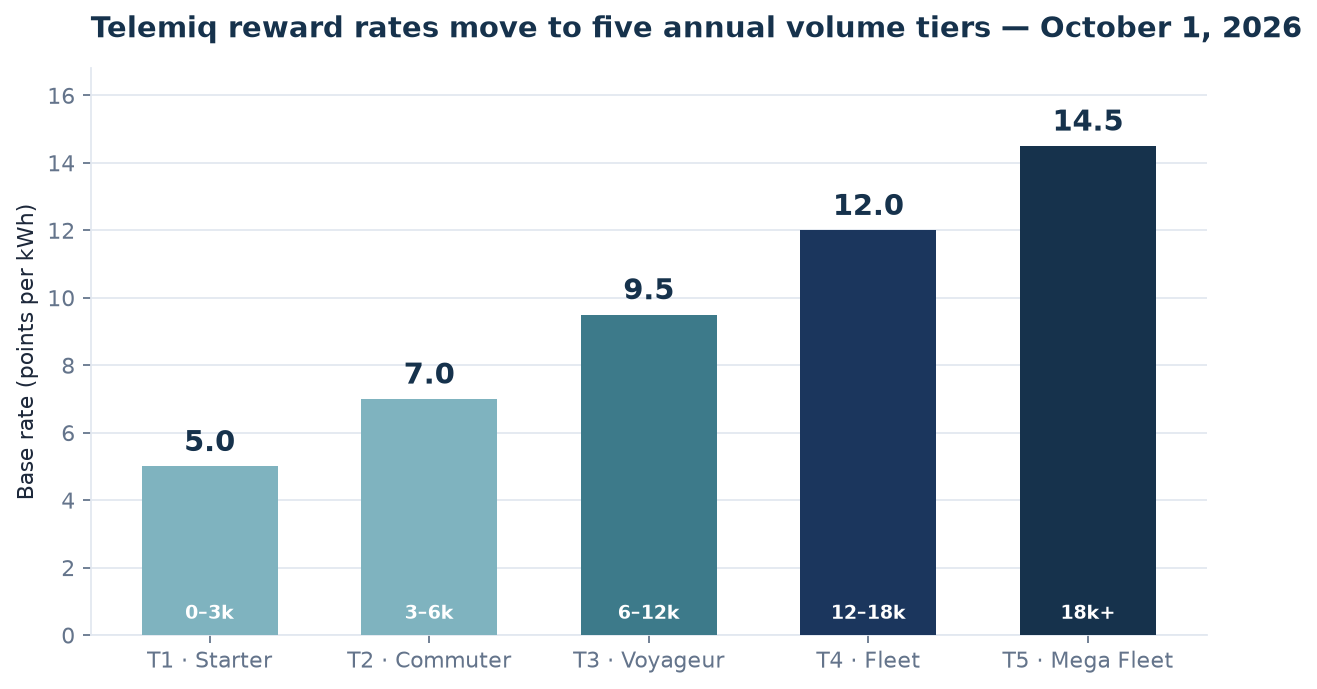
From October 1, the flat rate is replaced by a marginal bracket system — structured much like income tax brackets — that applies progressively higher rates as annual volume grows:
| Tier | Calendar-year volume | Base rate |
|---|---|---|
| 🌱 T1 · Starter | 0 – 3,000 kWh | 5.0 pts/kWh |
| 🚗 T2 · Commuter | 3,000 – 6,000 kWh | 7.0 pts/kWh |
| ⚡ T3 · Voyageur | 6,000 – 12,000 kWh | 9.5 pts/kWh |
| 🚚 T4 · Fleet | 12,000 – 18,000 kWh | 12.0 pts/kWh |
| 🏆 T5 · Mega Fleet | 18,000+ kWh | 14.5 pts/kWh |
There is no hard cap on annual earnings. The 21.75 pts/kWh figure is the natural ceiling — the Mega Fleet base rate multiplied by the program's maximum referral multiplier (more on that below).
How the brackets actually work
The most common misreading of a tier system is assuming the rate jumps for all of your charging once you cross a threshold. Telemiq's engine doesn't work that way. Each bracket's rate applies only to the kilowatt-hours inside that bracket, and the brackets stack:
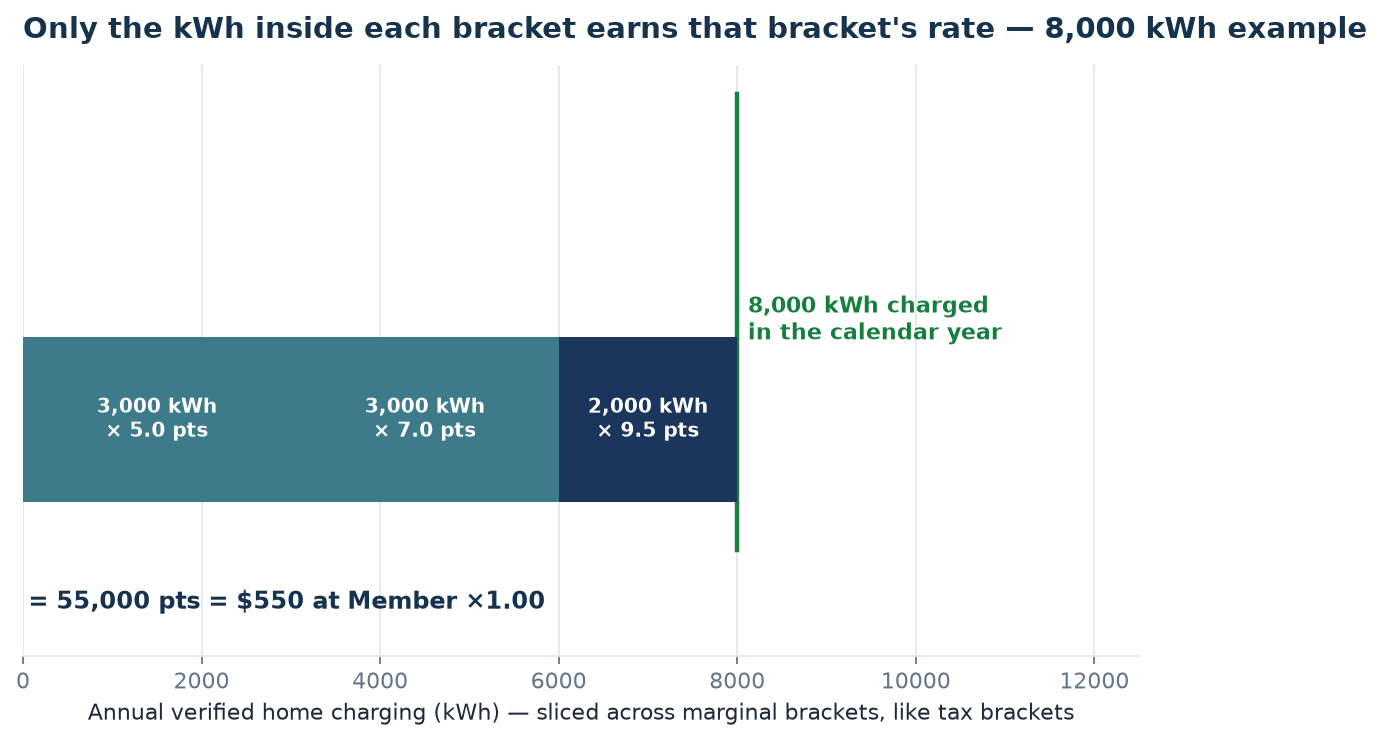
Take a driver who charges 8,000 kWh in the 2026 calendar year:
- First 3,000 kWh at 5.0 pts → 15,000 pts
- Next 3,000 kWh at 7.0 pts → 21,000 pts
- Final 2,000 kWh at 9.5 pts → 19,000 pts
- Total: 55,000 points — $550 at the base multiplier
That blended outcome works out to an effective rate of about 6.9 pts/kWh — well above today's flat 5, without needing to reach the top tier to benefit.
$10 per qualified referral — plus a multiplier that stacks on everything
The second half of the announcement is an upgraded referral program with two separate payouts that work together.
First, the cash: $10 (1,000 points) per qualified referral, each side. Every time a driver joins with your link and qualifies — meaning they reach 200 kWh of cumulative verified home charging on Telemiq — you receive $10 and they receive $10. Five qualified referrals is $50 in bonuses; fifteen is $150. A signup alone doesn't pay out: the referred driver has to actually charge, which keeps the program paying for real EV drivers, not abandoned signups.
Second, the multiplier: every qualified referral within the calendar year also moves the member up a multiplier band that applies to their entire tier rate — not just the newest kilowatts:
| Band | Qualified referrals | Multiplier |
|---|---|---|
| ⭐ Member | 0 | ×1.00 |
| 🗣️ Advocate | 1–2 | ×1.05 |
| 🥉 Bronze | 3–5 | ×1.15 |
| 🥈 Silver | 6–9 | ×1.25 |
| 🥇 Gold | 10–14 | ×1.35 |
| 👑 Platinum VIP | 15+ | ×1.50 |
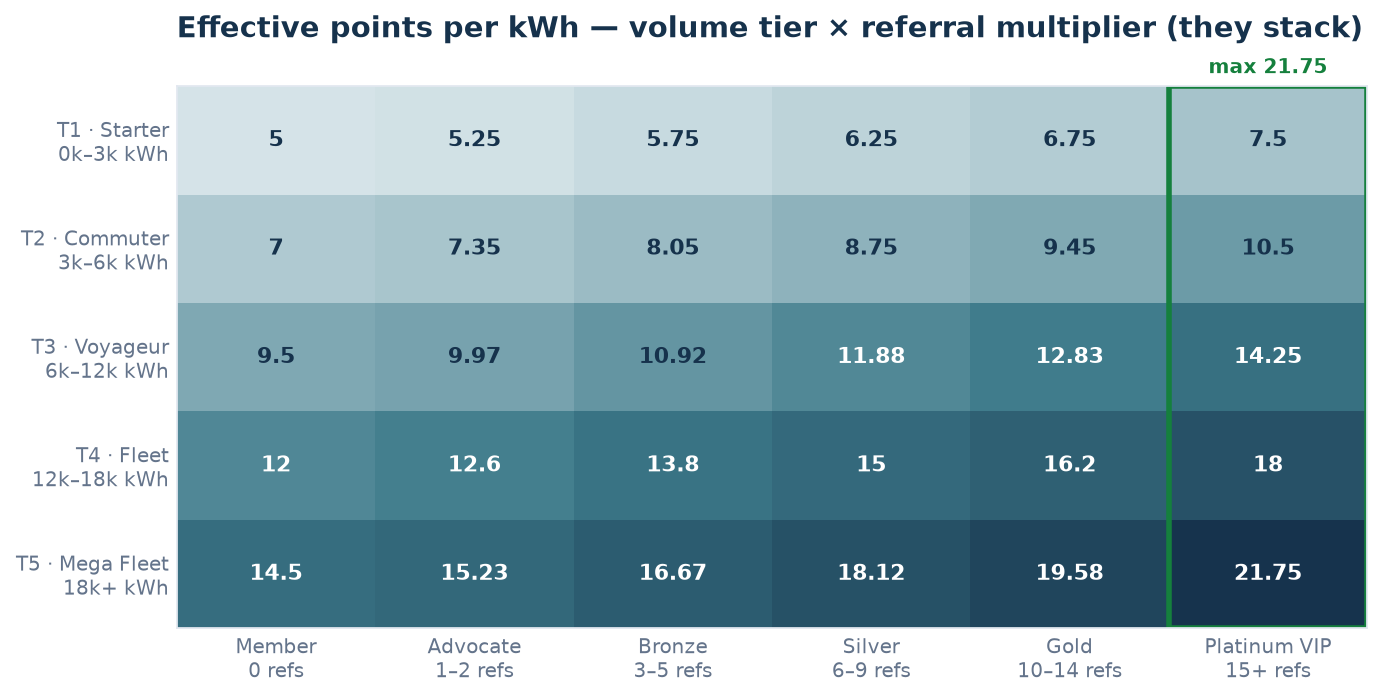
Read across any row of that matrix: the same annual volume pays more as the referral network grows. A Voyageur-tier driver (6,000–12,000 kWh) at Platinum VIP earns an effective 14.25 pts/kWh — a 50% raise on the identical driving, earned purely by bringing other drivers onto the platform.
What a year of charging pays
Combining the two systems produces the schedule Telemiq members will actually experience. The curves below show calendar-year cash value at four referral levels, against today's flat rate:
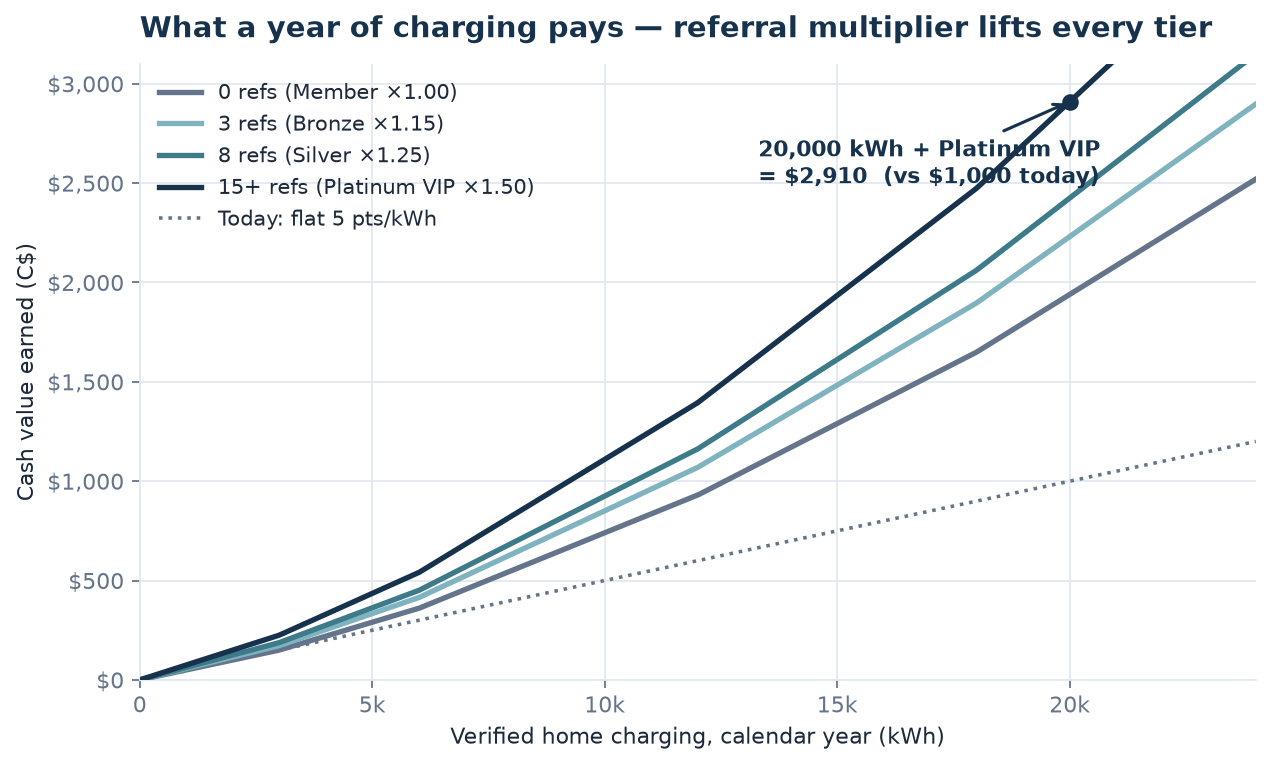
Some reference points from the schedule (charging value only — referral cash bonuses are on top):
- A typical commuter (about 2,500 kWh/yr — roughly 15,000 km) stays in the Starter tier and earns near today's rate. The system is deliberately gentle at the bottom.
- A heavy home-charging driver at 20,000 kWh/yr with no referrals earns $1,940 for the year — nearly double the $1,000 the same charging pays today.
- That same 20,000 kWh driver at Platinum VIP earns $2,910 in charging rewards — plus the $150 in referral bonuses it took to reach the 15-referral VIP band ($10 × 15, each side credited). Charging plus bonuses: $3,060, versus $1,000 under the old flat rate — a 3× improvement, or an effective 14.55 pts/kWh on the year.
The cash value is real: points convert at 100 points = $1.00 (C$) and are paid out by Interac e-Transfer following the program's annual carbon-credit audit in Q1.
Nobody starts from zero
Two transition rules soften the October 1 switch:
- Every kilowatt-hour charged before October 1 still counts. Pre-launch charging earns the current flat 5 pts/kWh, but the volume counts toward the member's calendar-year tier — a driver who has already logged 4,000 kWh this year enters October already inside the Commuter bracket.
- The calendar resets itself. Tiers and referral tallies are measured on the calendar year (January 1 – December 31), and counters are derived from that window automatically — no manual reset, and every member starts each new year with their earned history intact while tier volume begins fresh.
Who qualifies
Rewards are currently exclusive to Tesla vehicles: sessions are verified automatically through Tesla's official Fleet API with geofenced home-location confirmation. No dongles, no receipts, no manual claims — charging is detected and credited as sessions complete. Telemiq's multi-brand expansion (Ford, Hyundai, BMW, Rivian, GM, VW) applies to its Fleet API — the developer telemetry platform — not the rewards program; there is no timeline yet for rewards on other manufacturers.
The fine print, in plain terms
- Points, not promises: points accrue per completed, verified session; the award engine is idempotent, so a session can't be paid twice.
- Multipliers need qualified referrals: a signup alone doesn't move the band — the referred driver has to charge before the referral qualifies and the multiplier rises.
- $10 per qualified referral, both sides: the inviter gets $10 and the invitee gets $10 — explicitly both, not split — credited when the referred driver hits 200 kWh of cumulative verified home charging. And each qualified referral keeps working after the bonus: it lifts the multiplier band for the rest of the calendar year.
- Payout follows the audit: earnings accrue all year; cash-out follows the Q1 carbon-credit audit cycle.
Should you change how you charge?
For most members, no — the strategy is the opposite of rationing. Because higher brackets pay more per kilowatt, the economics now favor consolidating charging at home rather than spreading it across public networks. The members who benefit most are the ones who were already charging heavily at home: two-car households, high-mileage commuters, and drivers in the 12,000+ kWh range.
And for members with a Tesla-driving group chat, the math argues for organizing it: five qualified referrals pay $50 each side in bonuses, immediately — and turn into a ×1.15 multiplier on every kilowatt for the rest of the year, a raise that recurs every calendar year the network stays active.
The program goes live October 1, 2026. Drivers can preview their projected tier, multiplier band, and annual earnings with the calculator now live at telemiq.io.
Looking for EV deals, insurance, or financing? Check out our partner deals and offers.
If you found this guide helpful, use our Tesla referral link for free Supercharging credits on a new Tesla purchase or lease in Canada.
Affiliate disclosure: Charge News Canada uses affiliate links, which means we may earn a commission if you make a purchase through them, at no additional cost to you. Thank you for your support.
Next story · swipe left
Next story
Tesla Model Y vs the New 2027 Competition in Canada: Price, Range, Charging Compared
5 min read
The Model Y is still Canada's best-selling EV — but August 2026 pricing from Nissan, Toyota, and Mercedes gives buyers real alternatives. A trim-by-trim comparison of price after rebate, range, and charging access.
The Charge Brief
Get Canada’s EV transition in your inbox
One email a day. No spam, unsubscribe anytime.