

policy
As Counter-Tariffs Take Effect, Canada's Parts Lobby Warns a Weak Trade Deal Would Hurt More Than Tariffs
Hours before Canada's retaliatory tariffs on $27.6 billion of U.S. goods took effect September 8, APMA president Flavio Volpe said Washington is ready to hurt its own carmakers to win concessions — and warned Ottawa that a bad deal would trigger worse disinvestment than any tariff. USMCA exemptions hang in the balance.

The head of Canada's auto-parts lobby says the Trump administration is prepared to damage its own carmakers to win trade concessions — and he is warning Ottawa not to buy relief with a weak deal. Flavio Volpe, president of the Automotive Parts Manufacturers' Association, made the comments to The New York Times hours before Canadian retaliatory tariffs took effect on Tuesday, September 8.
The new levies of 15, 25 and 50 per cent on about $27.6 billion in American goods began just after midnight Eastern — Canada's answer to the 50 per cent duties Washington imposed on Canadian exports last month, after trade talks collapsed in late August and Prime Minister Mark Carney pulled negotiators out of the discussions.
"US assembly would stop within a week"
Volpe told the Times that when the Trump administration proposed collecting tariffs on Canadian auto parts last year, officials realized the measure would bring U.S. vehicle assembly to a standstill within a week. A year on, he says his members are not intimidated by another round.
His public campaign has framed the dispute in arithmetic terms. After U.S. President Donald Trump threatened on August 24 to raise auto tariffs to 50 per cent from January 1, 2027, Volpe wrote that the importer of record — not the Canadian supplier — pays the duty when parts cross the border. "The 'importer of record' pays the tariffs," he said. "A threatened US tariff on Canadian auto parts will be paid by US auto assembly," adding that without those specific parts, "auto assembly throughout the US would halt" — and that U.S. assemblers would be pressing the White House for relief the same day.
The numbers behind the standoff
- $27.6 billion in U.S. goods face new Canadian levies of 15, 25 and 50 per cent as of September 8.
- 90 to 95 per cent of vehicles assembled in Canada are exported to the United States, according to the Canadian Vehicle Manufacturers' Association and TD Economics.
- $110 billion in costs have been added to the North American auto industry by tariffs and trade disruption over the past 18 months, according to Lucas Malinowski, CEO of Global Automakers of Canada, as cited by CBC.
- 58 per cent — U.S. auto factories were running at this share of capacity as of April, their lowest in more than four years per Federal Reserve data.
- 7+ border crossings — components in a finished North American vehicle may cross the Canada-U.S. border seven or more times during production.
Why Volpe says a bad deal is worse than no deal
At a Unifor rally on Parliament Hill on August 28, Volpe described the costs of existing tariffs as "very damaging" — but said a weak agreement would be worse, warning that a bad deal could trigger disinvestment decisions whose consequences would far outlast any tariff, according to BNN Bloomberg. He has previously told The Globe and Mail that a compromise rate of 10 to 15 per cent on Canadian auto exports would not work for assemblers or parts producers, estimating the current effective rate at a minimum of 12.5 per cent and predicting automakers would eventually abandon Canadian production if such a rate were locked in permanently — following the pattern already visible at Stellantis' Brampton assembly plant, idled since late 2023.
Unifor National President Lana Payne struck a similar tone, telling BNN Bloomberg that Canada must be prepared to outlast the Trump administration and that concessions would not lead to a good deal.
What is actually being fought over
The dispute centres on the future of USMCA tariff exemptions. Parts meeting the agreement's rules of origin currently cross with a 25 per cent headline tariff but generally incur no duty. Analysts and Canadian officials speculate Washington may strip the USMCA exemption for many goods rather than target new product categories. During the last round of talks, Washington's offer would have lowered the tariff on Canadian-made vehicles to a headline 15 per cent — reducible to as low as 7.5 per cent with more U.S. content, CBC reported — a figure Canadian officials still considered too high. U.S. Trade Representative Jamieson Greer has demanded a 50 per cent U.S. content requirement in broader USMCA renegotiations.
For Canadian EV buyers, the stakes are concrete: pricing on U.S.-built electric models, parts availability for service, and the investment decisions that determine which EVs are built in Canada at all. Volpe's message is that the industry can absorb tariffs it has already absorbed — but cannot absorb a settlement that makes Canadian production permanently uneconomic.
Looking for EV deals, insurance, or financing? Check out our partner deals and offers.
If you found this guide helpful, use our Tesla referral link for free Supercharging credits on a new Tesla purchase or lease in Canada.
Next story · swipe left
Next story
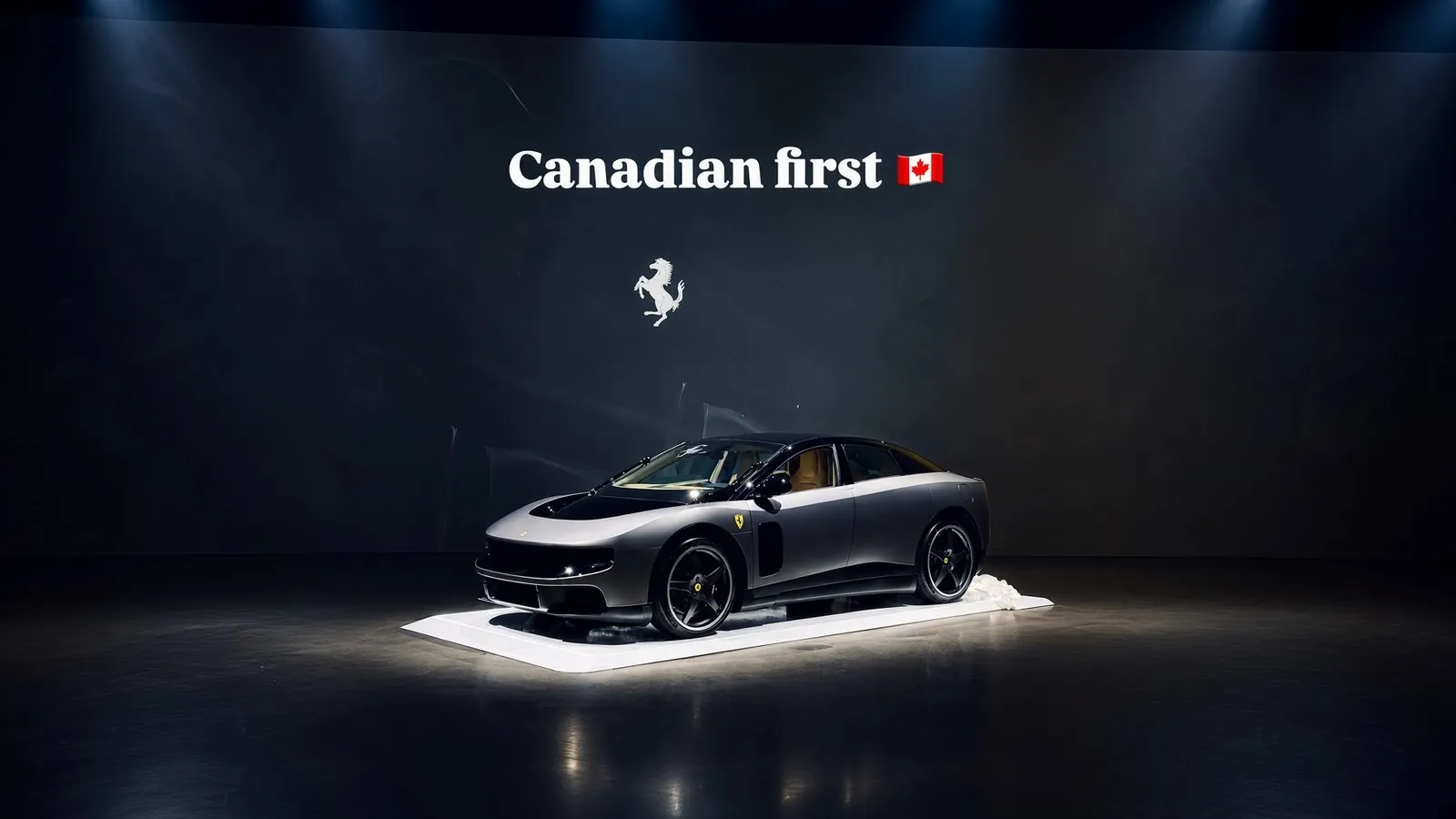
Ferrari Luce Heads to TIFF After Quebec Debut: Canada's First Electric Ferrari Tour Starts
4 min read
After its first Canadian appearance at Ferrari Quebec in a matte grey display spec, the 1,050-hp Ferrari Luce electric supercar heads to the Toronto International Film Festival — the second stop of its Canadian tour. Canadian pricing is still unconfirmed at roughly $800,000.
The Charge Brief
Get Canada’s EV transition in your inbox
One email a day. No spam, unsubscribe anytime.